
Research
One of our main focuses as a practice is theoretical and practical research in structural engineering. Whether this has direct applications in the current construction industry as practical innovations or not, is not as relevant to us as whether it has an actual meaning and potential. We would love to hear from practices, universities or any other organizations or individuals who want to collaborate with us on researching new construction materials, innovative building techniques or sustainable solutions. For architects and designers, DBSW is interested as well in participating in experimental proposals or cutting-edge approaches to design where structures play a significant role in the project.
Computation | Plastics | Timber | Concrete
AI — Surrogate Modelling
DBSW is actively developing the application of machine learning to structural design problems, with an initial focus on surrogate modelling as a means of accelerating iterative design processes. Where conventional finite element analysis requires repeated direct solution across a parameter space, a surrogate model — trained on generated structural data — learns the underlying relationships between inputs and outputs, enabling near-instantaneous prediction across the full design space without recourse to the solver.
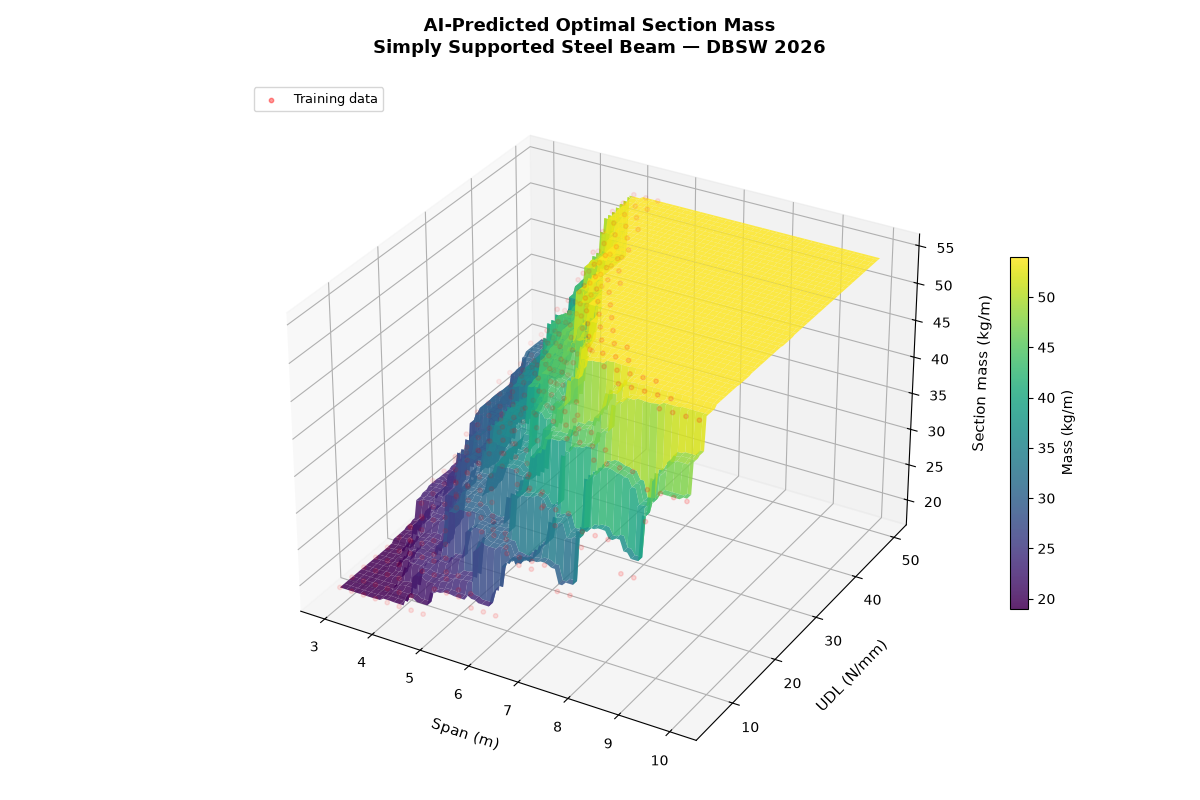
A first experiment applies this methodology to the selection of steel sections for simply supported beams under uniformly distributed load. A dataset of 551 design cases, generated programmatically across spans of 3 to 10 metres and applied loads of 5 to 50 kN/m, was used to train a Random Forest regression model. The trained model predicts optimal section mass with a mean absolute error of 2.74 kg/m — consistent with the discrete increments of the section library — and generates a continuous prediction surface across the full design space from two input parameters alone.
The figure below presents this surface alongside the training data. The methodology scales directly to structurally complex problems where repeated finite element solution carries significant computational cost: multi-span systems, non-linear material behaviour, form-finding under geometric constraint. Further research will extend the approach to these configurations and explore optimisation across wider and more demanding structural design spaces.
Topology & Structural Form Optimization
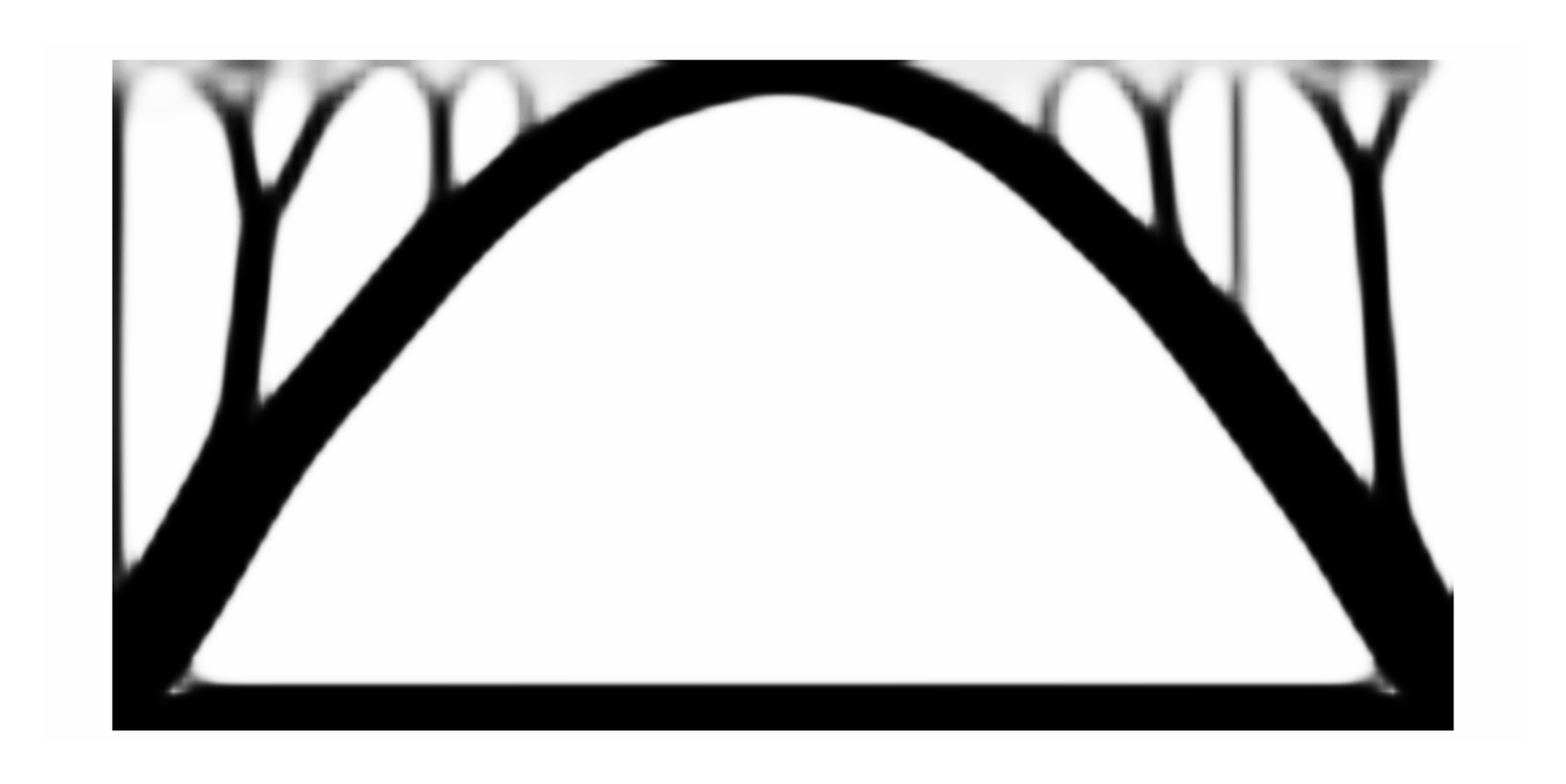
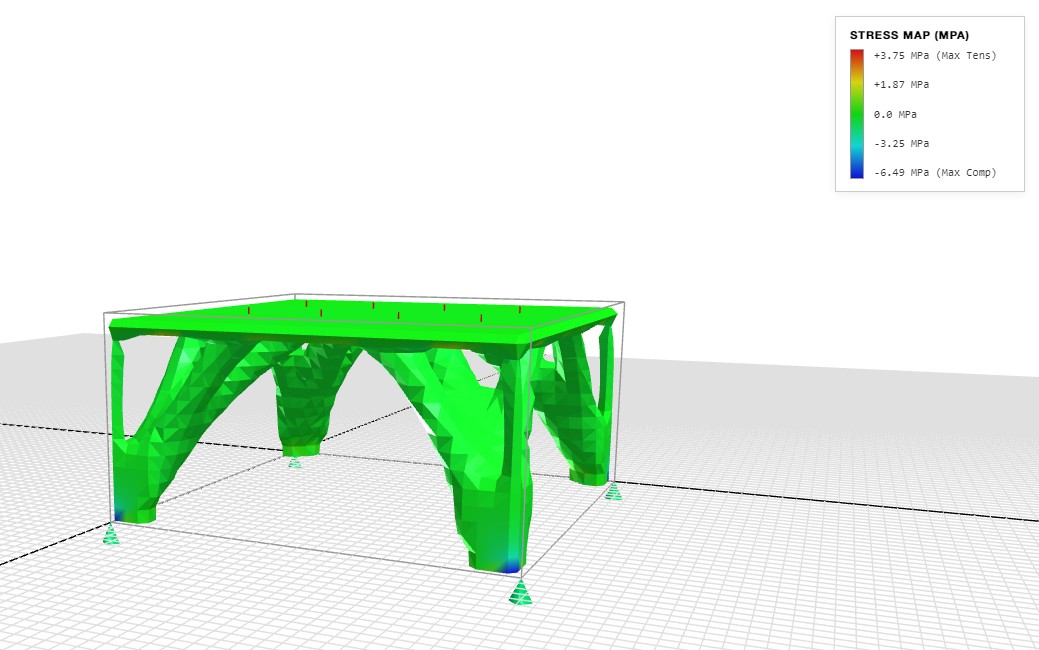
Topology optimisation seeks the most structurally efficient distribution of material within a given design domain — the form that minimises deformation for a prescribed volume of material, without any preconception of what that form should be. Unlike conventional structural design, which begins with a chosen structural type and refines it, topology optimisation begins with physics alone and allows form to emerge.
DBSW implements the SIMP method — Solid Isotropic Material with Penalisation — a gradient-based optimisation algorithm that iteratively redistributes material within a discretised finite element domain. Each element carries a density variable between zero and one. At each iteration, a finite element analysis determines which elements contribute most to structural stiffness; material migrates towards those elements and away from those that contribute least, subject to a constant volume constraint. The process repeats until convergence.
The first figure presents the result for a uniformly distributed load applied across the full span of a simply supported domain, with 30% volume fraction and 80 iterations at 120 × 60 element resolution. The algorithm derives a classical Michell arch — a compression arch with vertical compression struts or tension hangers — without being given any information about arch behaviour, span-to-depth ratios, or structural typology. The form emerges entirely from the applied boundary conditions and the physics of minimum compliance. This result is one of the canonical solutions in structural optimisation theory, first described analytically by A.G.M. Michell in 1904. Its independent derivation here through numerical optimisation confirms both the correctness of the implementation and the power of the method to recover known structural truths from first principles.
The second figure presents the converged topology for a slab supported over a 3D domain seeded with four discrete point supports. Without pre-programmed knowledge of column buckling or shell action, the algorithm strips away inefficient mass from the solid design domain and independently derives a branching, tree-like support arrangement, each trunk bifurcating naturally as it rises to gather load into the flat plate above. The form emerges strictly from the boundary conditions and the mechanics of compliance minimisation, tracking the stress field as material is removed. Its independent derivation of load-shedding branch geometry — rather than the straight, single-stem columns a designer might default to — confirms both the kinematic validity of our element formulation and the accuracy of the 3D filter kernel in recovering efficient force paths from first principles.
Further work will extend the implementation to arbitrary boundary conditions, multiple load cases, and non-rectangular design domains — enabling genuine generative structural design for bespoke and specialist structures. To support this research, we developed a first-principles, FEA solver. You can run a limited trial version of this 3D SIMP topology engine directly on your browser.
Acrylics and Resin Materials
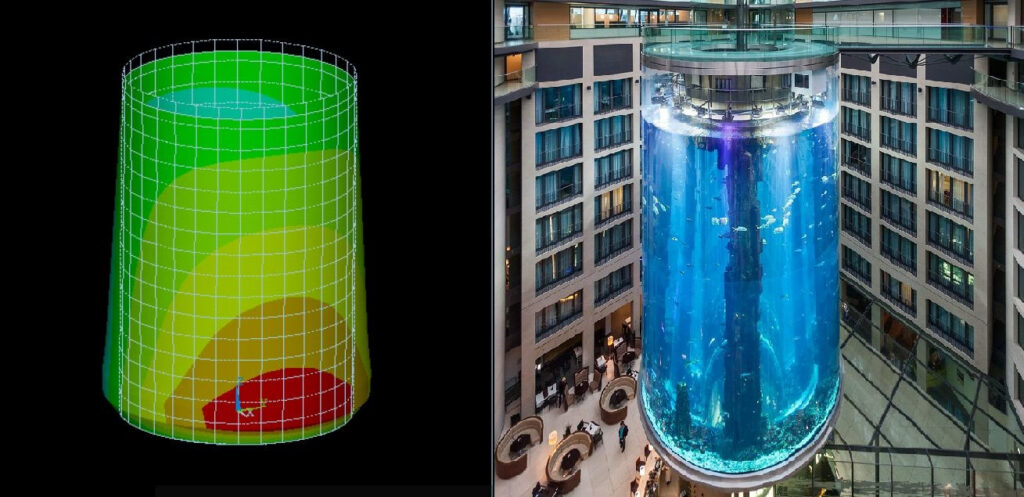
A persistent research interest at DBSW concerns the structural application of materials not conventionally associated with load-bearing function. The trajectory of glass is instructive: once considered unsuitable for structural use, it is now reasonably well understood mechanically and accepted in its own right as a structural material. A similar progression has been observed with methacrylate, where earlier research examined structural performance under water-retaining conditions. This work led to collaboration with the Aquarium Finisterrae in Galicia, Spain.
More recently, attention has turned to fibre-reinforced and glass-reinforced polymers — FRP and GRP — not solely as plate or shell elements but as framing components capable of bespoke geometries that conventional materials cannot economically achieve. Foundation applications have also been considered, as a partial substitute for concrete in specific conditions.
The plastic manufacturing industry has yet to develop cast-in-place or precast systems suitable for structural frames and floor construction at scale. Recent inclusion of these materials in technical guidance may however mark a shift in how the industry regards their structural potential.
Sustainable Fabric-Reinforced Plastic Modular Structures
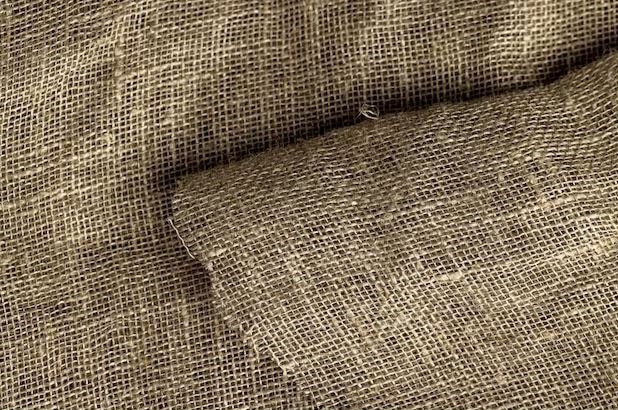
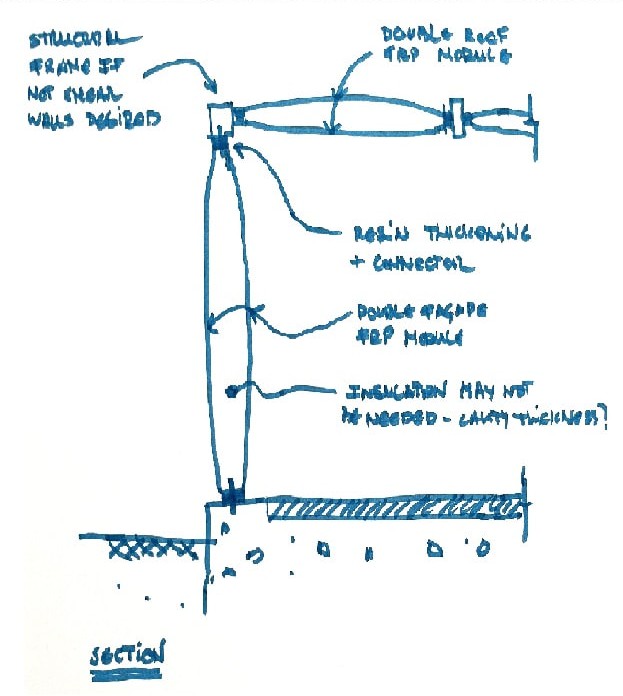
Fibre-reinforced plastic is not a new technology and it is often used to form structural shells or plates, spanning either one-way or two-way between supports. These supports can either be provided by typical frames or by other 2D fibre-reinforced elements adequately arranged and with connectivity provided by cast-in-place steel fixings.
This research is focused on fabrics — in lieu of randomly distributed fibres — as a new construction approach relying on resins as matrices with a clear focus on modularity and sustainability. The sustainable aspect relates to organic or recycled-based fabrics where the resins are poured onto. These fabrics not only provide a foundation for the resins to settle and bind – especially for shell elements — but also provide mechanical strength and architectural properties such as texture, colour and opacity to the composite element. The modularity, intimately linked to ease of manufacturing implementation and repetition, is achieved by simple methods of casting where moulds shaping the fabric contour are used to provide the desired form of shell or plate, without the need of high-temperature kilns or autoclaves. The composite thickness — relevant to insulation and structural strength — of these elements can be achieved by prescribing the desired resin thickness or selecting the thickness and number of layers of the fabrics. Shells and plates can be used as single-sheet or multi-sheet systems, depending on the structural and architectural requirements. Even if this system can be classified as well as FRP, conceptually this would be part of a new family of structural solutions.
These modular structural elements can be either installed as envelope components — facade or roof as they are waterproof — or internally. Their structural function can either be local if installed with traditional structural frames providing the overall system stability or global as well if used as internal shear walls as previously mentioned. For enveloped applications, the use of shells — either sandwiched with insulation or not — is preferable due to their intrinsic out-of-plane mechanical strength. For internal shear walls, the use of plates is desirable for geometric, manufacturing, and strength reasons (in-plane stresses).
Post-Tensioned Cable-Stayed CLT Plates
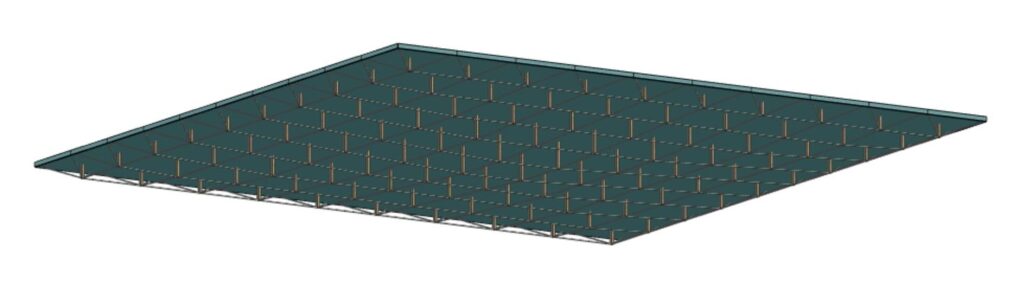
This spatial system comprises timber — both CLT plate and timber stays — and steel cables designed to stiffen the structural plate as a stayed system. Although spatial systems, especially for roofs, have been used for a long time now, the combination of large-format CLT plates together with timber stays and steel cables has never been proposed for long-span structures. Aside from the good structural behaviour of the CLT in compression and bending locally spanning between inverted solid timber stays, the system includes 2-way spanning cables anchored to the perimeter either via linear supports able to deal with in-plane bending and gravity loads or to the CLT plate by steel connectors at the edge, designed both to transmit compressive stresses parallel to the grain and vertical reactions to the rest of structure.
The timber stays are detailed to be moment-connected to the CLT plate soffit with steel cap plates, providing adequate bearing and moment resistance via resin-anchored dowels. The opposite free edges are provided with steel endplate connectors articulating the cable bearings. As with any other non-linear system, calculating the length of the stays and cable pre-stress requires several analysis iterations. In order to optimize the design the depth of the stays needs to be variable, with the depth proportionate to the system’s deflection and moment distribution considering the plate stiffness, if these are arranged vertically. For diagonally arranged stays, a constant depth of the structural system can be prescribed instead. Structural analysis modelling has shown that expected typical failure modes, depending on the support conditions, are related to CLT buckling for low depth-to-span ratios, representing a design approach based on a material cost bias. However, considering the ample flexibility of geometries achievable regarding the grid centres, the system’s overall depth or the CLT plate section sizes, this system is generally expected to compete with other spatial structures, such as flat double-layer grids. In the image, a 200mm CLT plate spanning 30 meters has been achieved as a lightweight roof structure with timber vertical stays 1.25 meters deep (maximum) at 3-meter centres.
Other systems similar to this include cable-stayed timber glulam beams or pre-stressed timber beams, see below, which could offer similar depth-to-span ratios at the expense of a higher selfweight.
Pre-Stressed Timber Beams
Although timber has reasonable mechanical strength in terms of structural bearing capacities, it is far from the typical structural steel parameters. Therefore, it makes sense that steel reinforcement can be used to improve timber performance, especially regarding its tensile capacity. In this particular study, steel reinforcement is presented as prestressed cables instead of steel plates, which are normally used in flitched beams, for example.
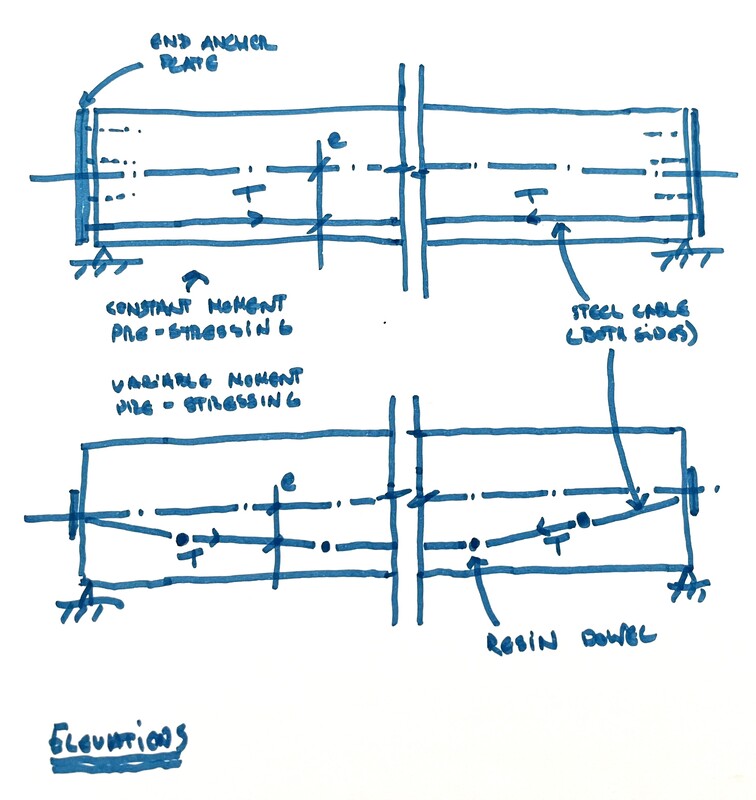
There are two proposed alternatives. The first involves prestressing cables to provide a constant balancing moment (CBM) along the beam’s longitudinal axis (elevation on top in the image). The second involves a variable balancing moment (VBM) for a simply supported beam. Although the latter proposal is more efficient structurally, it requires more complex detailing, as explained below. Both systems require end anchor plates and tension cables, which include turnbuckles for tension adjustment. They can be installed both internally (recommended for hollow timber sections) or externally to the beam, which is advisable for solid or mass timber beams. For the CBM option, end plates anchor the prestressed cables running along both sides of the beam if these are to run externally. The VBM configuration, on the other hand, requires not only end anchor plates but also intermediate resin-dowelled connections into the beam, with increased eccentricities at locations of higher bending moments. These dowelled connections have limited capacity and therefore the achievable balancing moment is substantially lesser than CBM beams which relies on the end bearings only.
In the diagram above, a simply supported beam is exemplified, but other arrangements, such as cantilevers and intermediate supported beams, follow the same principles. The main advantages of prestressed timber beams include increased stiffness compared to the same unreinforced timber sections. This results in increased load-bearing capacities, reduced deflections, increased durability (as compressive stresses minimize the occurrence of cracks) and material efficiency.
Vaulted Mass Concrete Slabs
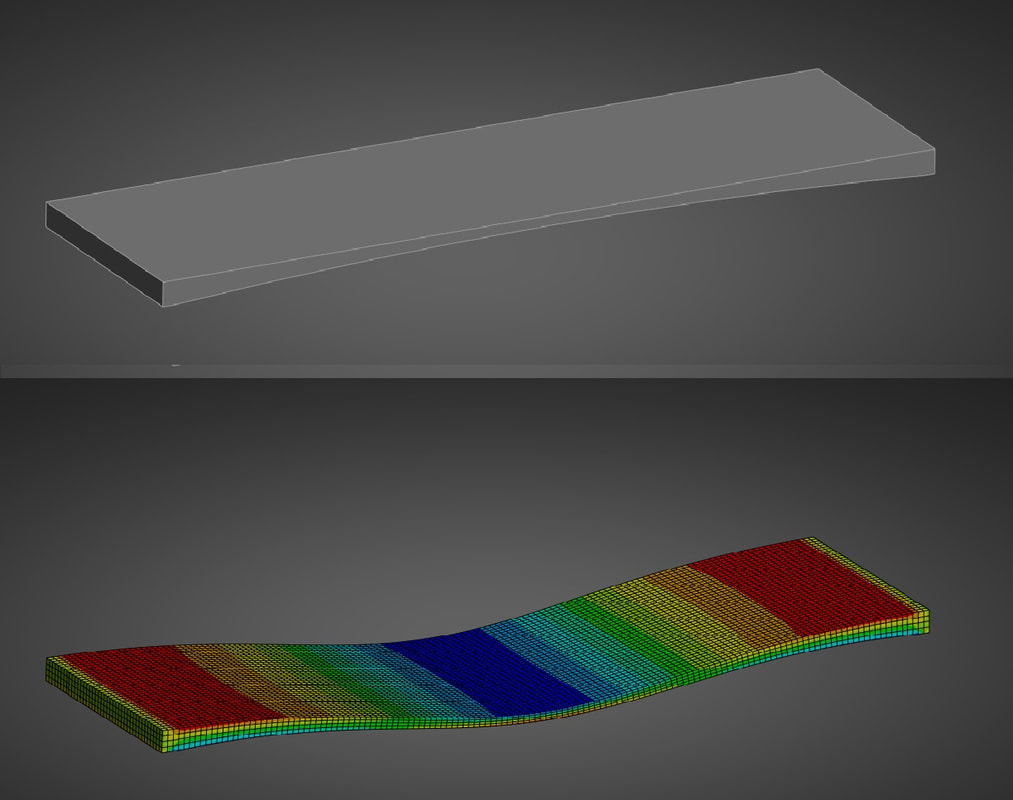
Vaulted structures, such as masonry or concrete arches and vaults, have been amongst us for several millennia. Their intrinsic structural strength, provided purely by their form, was first exploited by the Romans, who knew few other technologies capable of allowing for large structural spans. Over the centuries, other cultures adopted this strategy, including Victorian structural engineers.
While this research does not introduce a conceptually new solution, it offers modern analysis, detailing, and manufacturing considerations for this structural system as an alternative to the widely used precast or composite floors in today’s construction industry.
Our study involved the structural analysis of several mass concrete planks, with spans ranging from 3 to 6 meters and depths between 50 to 150mm at the supports. At the vault crown, the thickness decreases to create the arched intrados, maintaining a minimum thickness of 40mm for practical construction considerations. The analysis considered typical residential and commercial imposed loads. Results showed excellent performance both in terms of deflection criteria and mechanical strength without the need for steel reinforcement if very low concrete strength grades are avoided. Precast manufacturing techniques under controlled environments are expected to negate the need for steel reinforcement in terms of limiting cracking due to shrinkage. For large concrete pours, fibres could also be considered instead of steel reinforcement. In terms of robustness, vaulted mass concrete slabs can be designed to resist tying tensile forces, including at the bearing positions via resin anchors or cast-in-place connectors. In terms of lifting operations, steel reinforcement may be needed for large format units, unless sandwich lifting reinforcement frames are used during installation.
Shell vaulted design leverages the natural strengths of concrete, allowing for a more efficient distribution of material. This design not only enhances structural integrity but also minimizes the amount of concrete required without the need for steel reinforcement, leading to substantial environmental and construction cost benefits.